Scale factor word problems show up in 7th grade math because they connect abstract ratios to everyday measurements. Students work through them to learn how objects change size while keeping their exact shape. Mastering these problems now builds a clear path into geometry, proportional reasoning, and basic technical drawing. Instead of guessing or memorizing isolated steps, you learn to compare lengths logically and verify answers with simple multiplication or division.
What does scale factor actually mean in a word problem?
A scale factor is a ratio that tells you how much larger or smaller a new figure is compared to the original. If a problem states a scale factor of 4, every side length in the new drawing is four times the original. If the scale factor is 1/3, each measurement shrinks to one-third of its starting size. Seventh grade questions usually hide this ratio inside short scenarios about maps, posters, or model models. Your task is to locate the original measurement, identify the multiplier, and apply it to the correct dimension.
When will you actually run into these problems outside the classroom?
You will use scale factors anytime something needs resizing without distorting its proportions. Engineers shrink bridge designs to fit on standard paper. Photographers crop and resize images for specific frames. Even reading a road map requires converting scaled inches into actual miles. Working through practice sheets that mimic blueprint resizing helps you see how the math translates to physical measurements and why accuracy matters.
How do you solve a typical 7th grade scale factor problem?
Most questions follow a predictable pattern. You receive an original length, a scale factor, and a prompt asking for the new length or the starting length. Write down the known values first. Then determine whether the figure is growing or shrinking. Multiply the original measurement by the scale factor to find the enlarged size. If the problem gives you the scaled measurement and asks for the original, divide instead. Keeping your units consistent from start to finish prevents most calculation errors.
Can you walk through a quick example with real numbers?
Imagine a rectangular patio drawing where the actual width is 16 feet. The problem says the sketch uses a scale factor of 1/4. To find the drawing width, multiply 16 by 1/4. The result is 4 feet on paper. If the question flips and tells you the sketch measures 6 inches with a scale factor of 3, you divide 6 by 3 to recover the original 2 inches. Writing the ratio as a fraction before calculating makes the operation obvious. You can also compare matching sides of two rectangles to double-check your multiplier before moving to the next step.
Where do most students get stuck?
The most common mistake is mixing up enlargement and reduction. A scale factor greater than 1 always increases size. A fraction between 0 and 1 always decreases it. Students also forget to apply the factor to every relevant side, which breaks the proportional relationship. Another frequent error is treating area the same as length. Scale factors apply directly to linear measurements. If a word problem asks about area, you must square the scale factor first. Skipping that adjustment throws off the entire answer.
How can you practice without wasting time on confusing problems?
Start with single-step length conversions before attempting multi-part scenarios. Sketch the original and scaled shapes side by side so you can visually confirm whether the size change matches the given factor. Label every number clearly and cross out extra details that do not affect the ratio. When you feel steady with basic conversions, try grid-based drills that track how coordinates shift during an enlargement. Watching the points move on a plane makes proportional changes much easier to recognize. For additional context on how these skills align with classroom expectations, you can review the 7th grade ratio and proportion guidelines published by state education frameworks.
What should you do next to build confidence?
Use this short routine each time you open a new set of scale factor word problems for 7th grade:
- Identify the original measurement and the scale factor before writing any equations.
- Convert decimals to fractions when possible to simplify multiplication or division.
- Multiply for enlargements and divide for reductions, then verify the direction makes sense.
- Draw a quick rough sketch to check whether your answer looks proportional.
- Separate area or volume questions and adjust the scale factor accordingly before calculating.
Keep a small log of missed problems and note whether the error came from misreading the factor, flipping the operation, or mixing up units. Ten minutes of focused practice daily builds faster accuracy than rushing through a full packet right before a quiz. Once the steps feel routine, these word problems stop feeling like puzzles and start working like straightforward measurement tools.
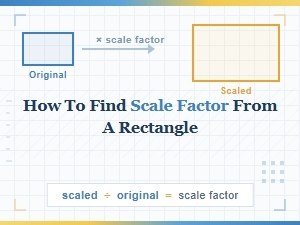 A Guide to Calculating Scale Factor for Rectangles
 Identifying the Scale Factor in Similar Triangles
 Exercising with Coordinate Plane Enlargements
 Mastering Scale Factors in Architectural Drawing
 Exploring Scale Factors in Middle School Geometry
 Understanding Map Scale Factor Calculations