Working through an identifying scale factor in similar triangles worksheet gives you a clear way to practice proportional reasoning without guessing. When two triangles share the same shape but differ in size, the scale factor tells you exactly how much one has been enlarged or reduced. Getting comfortable with this skill early saves time later in geometry, drafting, and even everyday tasks like reading maps or resizing images.
What does scale factor actually mean here?
The scale factor is simply the ratio between matching sides of two similar triangles. If triangle ABC is similar to triangle DEF, you compare side AB to DE, BC to EF, and AC to DF. When the triangles are truly similar, all three ratios will match. That matching number is your scale factor. A value greater than one means the second triangle is larger. A value between zero and one means it is smaller.
When will you actually use this worksheet?
Teachers assign these practice sheets to build fluency before moving into proofs, trigonometry, or coordinate geometry. Students use them to check their work quickly and spot patterns in proportional figures. If you are preparing for standardized tests or working on real-world measurements, the same reasoning applies. You can even connect this practice to finding scale factor from a rectangle when you need to compare four-sided figures using the same ratio logic.
How do you find the scale factor step by step?
Start by matching the correct sides. Look for tick marks, angle labels, or the order of vertices in the similarity statement. Write the ratio as new length over original length if you want the enlargement factor, or original over new if you want the reduction factor. Divide the numbers. Check your answer by testing a second pair of sides. If the second ratio matches the first, you have the correct scale factor.
For example, if side AB measures 4 cm and the matching side DE measures 10 cm, divide 10 by 4 to get 2.5. Test another pair: if BC is 6 cm and EF is 15 cm, 15 divided by 6 also equals 2.5. The scale factor is 2.5, and the second triangle is an enlargement.
Watch out for these common mistakes
- Mixing up corresponding sides instead of matching angles first
- Dividing in the wrong direction and flipping an enlargement into a reduction
- Assuming triangles are similar without checking angle measures or side ratios
- Forgetting to simplify fractions before comparing ratios
- Using perimeter or area directly instead of side lengths to find the linear scale factor
What makes these worksheets easier to finish?
Label every vertex before you start calculating. Write the similarity statement down so you know exactly which sides pair together. Keep a small table on your scratch paper to track each ratio. If a problem gives you mixed units, convert them first. When you hit a fraction, leave it unsimplified until you check the second pair, then reduce both at the same time. This habit cuts down on arithmetic errors.
If you want to stretch your practice beyond triangles, try a scale factor worksheet for architectural drawing practice to see how the same ratios apply to floor plans and elevation sketches.
How do you know your answer is correct?
Test all three side pairs. If even one ratio differs, the triangles are not similar or you matched the wrong sides. Double-check your division. Remember that scale factor applies to lengths only. Area scales by the square of the factor, and perimeter scales linearly. If a question asks for area changes, multiply the original area by the scale factor squared. Keeping that distinction clear prevents lost points on mixed-concept problems.
You can also verify your work against trusted geometry references like the Khan Academy similarity lessons when you need a quick refresher on proportional sides and angle relationships.
What should you practice after finishing the sheet?
Move on to word problems that hide the triangles inside real situations. Shadow length questions, map scaling, and model building all rely on the same ratio thinking. Working through scale factor word problems for 7th grade will help you translate diagrams into equations and back again. Once you can set up the proportions without hesitation, you are ready for coordinate dilations and similarity proofs.
Quick checklist before you turn it in
- Matched sides using angles or vertex order, not just visual guesswork
- Divided new length by original length for enlargement, or reversed for reduction
- Checked at least two side ratios to confirm they match
- Converted units so both measurements use the same scale
- Kept length, perimeter, and area scaling rules separate
Run through those steps on your last problem. If everything lines up, mark your final answers clearly and move on to the next set of proportional figures.
 Mastering Scale Factor Word Problems
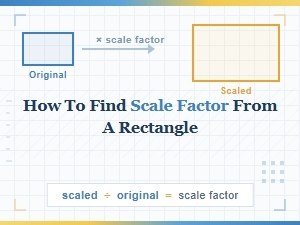 A Guide to Calculating Scale Factor for Rectangles
 Exercising with Coordinate Plane Enlargements
 Mastering Scale Factors in Architectural Drawing
 Exploring Scale Factors in Middle School Geometry
 Understanding Map Scale Factor Calculations